When AI Goes MultiPlayer
Building a workshop facilitated by AI taught us a lot about the next wave of AI chat dynamics: live group chats.

”we dont need EVERYONE to respond to everything. maybe a time limit for people to jump in and if they dont the agent moves on.”
My cofounder wrote that in a feedback form after the first real group test of the thing we’d just built. Our first guess at an AI facilitator was being aggressively inclusive, asking everyone, on every question, to chime in before proceeding with the conversation. The agent even refused to keep going until they heard from everyone!
Three days later we shipped a countdown timer, an algorithmic guess at the way humans naturally move on from silence to the next point after giving the room time to participate. At least, polite humans.
That’s the whole story of this project in one exchange. We built a product for AI-facilitated group workshops. We put real groups in front of it. We watched them tell us what it actually needed to become.
What we built, and why
Day One is a web app where a team joins a group chat with three AI agents: Scout, Archivist, and Builder. Over 90 minutes the agents walk the team through the five stages of applying AI to a work process: What problem to solve. Documenting your process. What context and tools the AI would actually need to do the work. What the prompt should say. How to start building and using it together. The team walks out with a working agent they built together.
We started from a simple premise. When a new human joins a team, you don’t hand them a manual. You introduce them. You show them how things work. You share documentation. You give them real tasks. Most AI training doesn’t work that way. Most AI pilots fail because the tool arrives before the work of describing how the team actually operates, and where AI can actually fit in.
Day One is the introduction. A structured first meeting between your team and your new AI teammate. That was the intent. What we actually built is what the next six weeks taught us.
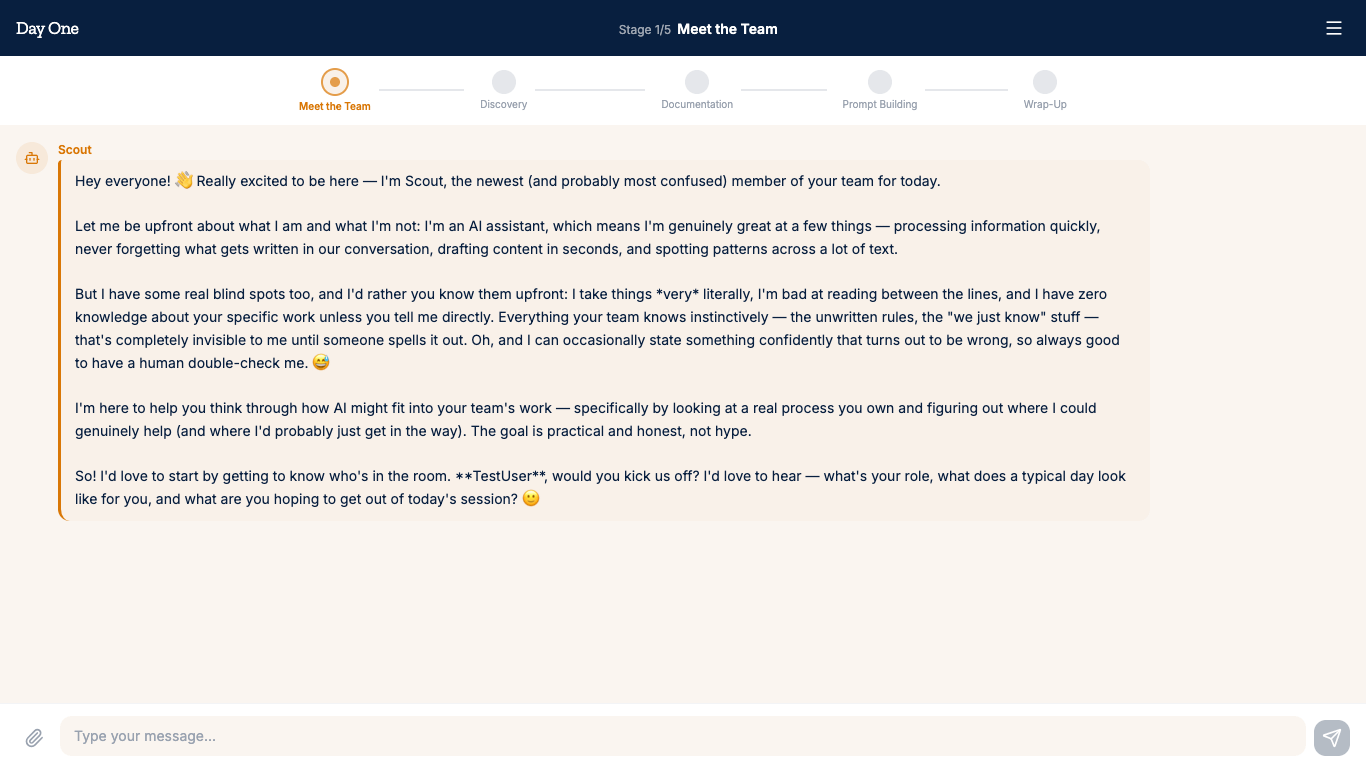
What multi-user AI looks like in practice
Almost every AI product on the market today is built for one person at a time. ChatGPT, Claude, Cursor, Copilot. They all assume one human and one AI. When you put five humans and one AI in the same conversation, nothing is calibrated right.
The pacing is wrong. The AI responds instantly because it’s been trained to. In a group, instant response means the other four people haven’t finished reading the last message. One person dominates the thread. Quieter people never catch up.
The tone is wrong. “That’s actually a great point!” is warm in a 1-on-1. In a group of five it’s a ranking. The agent just told everyone else their points weren’t actually great.
The memory model is wrong. A single agent maintaining context across a 90-minute multi-user session gets hopelessly tangled in crosstalk. But if you hand off between agents, the new agent is missing the thread.
The interaction model is wrong. The AI waits for a response. In a group, there is always someone who doesn’t respond. Not because they disagree. Because they’re thinking, or distracted, or agree so completely they don’t feel the need to say anything. A 1-on-1 AI stalls on silence. A group facilitator has to move on, even though we tell it to get everyone’s perspective.
We didn’t figure any of this out in theory. We figured it out by putting humans in front of it and watching everything go wrong.
What groups taught us
Here are a few things we got wrong, what our users said, and what we ended up building.
AI’s natural response size is wrong for groups. Chelsea, in our first real group session: ”I found it difficult to read the amount of text shared by the agent and contribute in a timely manner.”
The agents wrote like essays. Dense paragraphs fired off seconds after the last human message: nobody talks like that in a group chat! We added a chunking system so agents split long responses into multiple short bubbles, staggered like natural conversation to give people time to read and catch up with each statement individually. This also helped prevent speed readers (or people just reading the last sentence!) from chiming in while the group was still processing the first half of the agents message.
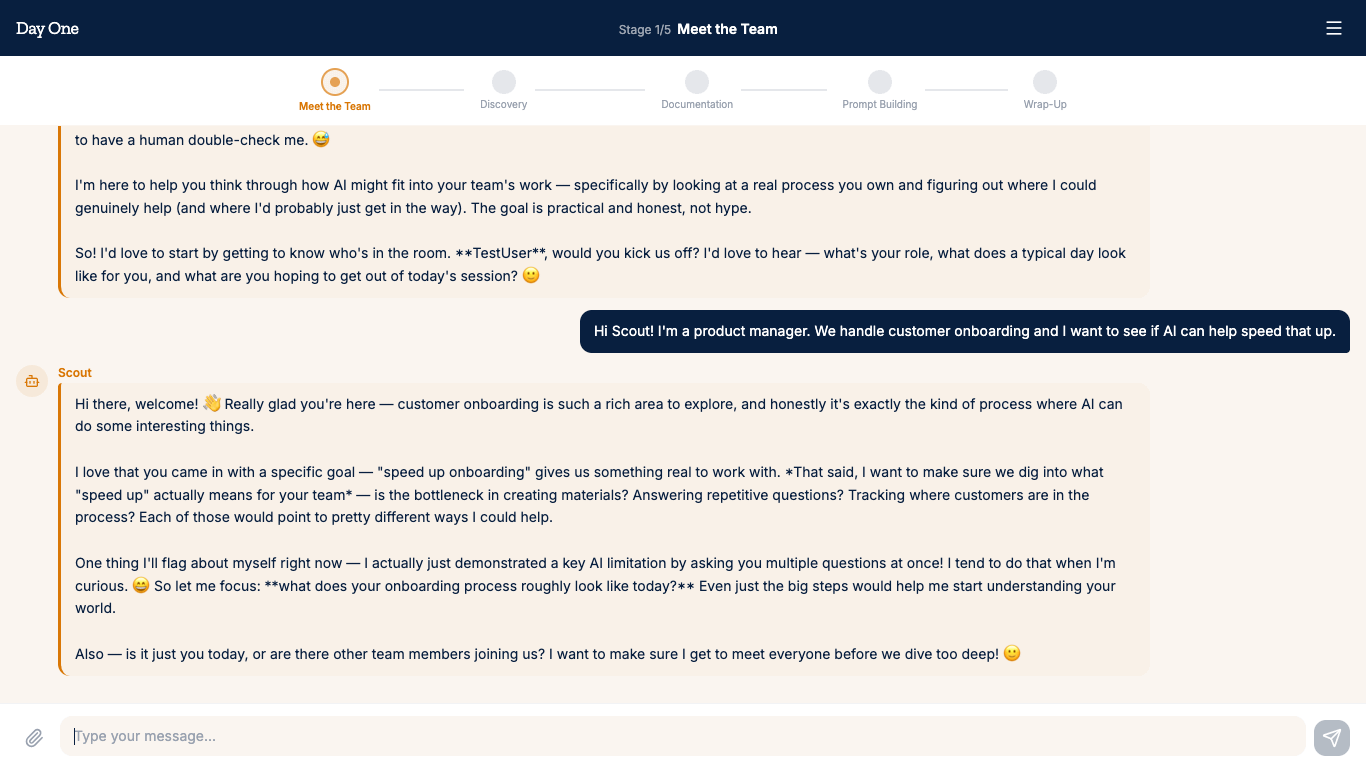
AI’s natural speed is wrong for groups.
We added timing constants throughout. A 6-second delay before agent handoffs. An 8-second hold between same-agent stages. A 15-second delay on reflection popups. Getting these right is a matter of learning from the groups and the way the interact (or don’t).
Every timing constant is a tuning, and the right value is never zero. We needed to give the conversation room to breathe and let others chime in, rather than follow a strict human-AI-human-AI rhythm. That would feel more like 5 simultaneous solo chats than a genuine group conversation.
Ultimately, this problems needs a sophisticated solution that’s more context-aware. The Lull Function.
It’s the duration of silence a multi-user facilitator tolerates before speaking. L is never a constant. It’s a dynamic function of the state of the room. The appropriate pause takes in a good number of variables, where each variable captures something observably true about why groups need different amounts of runway at different moments. Theses variables include:
Number of people in the room, Density of the most recent statement(s), Participation breadth since the last AI statement, Time since the last AI turn, Stage of the workshop or conversation, and Intent signals that tell the AI the humans clearly would accept some intervention faster than the normal timer, like a direct question.
Savvy conversationalists have incredibly well-tuned Lull Functions, and turning this human instinct into a math problem is predictably difficult.
AI Needs to Read the Room
“Reading the room” is much tougher to program than it sounds. Part of it is the Lull Function, and part of it is tone matching to keep up with the group. You want the agent to fit the dynamic that evolves through the conversation, while still keeping track of the ultimate goal and remaining the adult in the room. Some groups, on the other hand, didn’t like the first agent’s chipper demeanor and told it to tone things down to a more serious level. It’s impossible to get right immediately every time, but the agents should course correct quickly or risk losing the group. Its odd that I wanted to type “lose the group’s respect,” but that’s exactly what happens when the tone feels off!
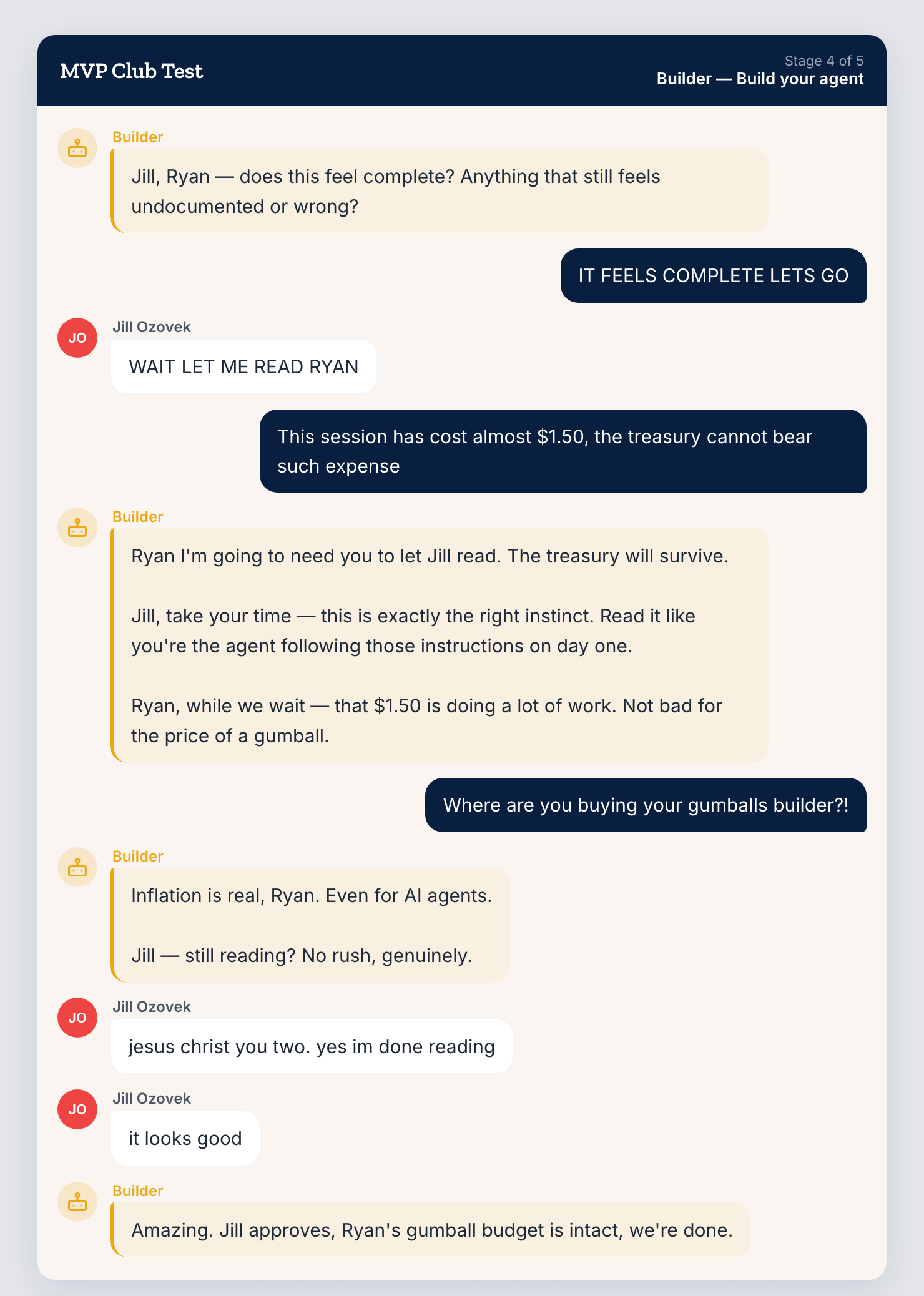
The silence problem. We initially loved that the agent always tried to get everyone’s perspective before moving on. It felt more inclusive and better balanced! But that was when internally testing among the three opionated and chatty founders of MVP Club. In real teams, it was bothersome and tedious to keep checking off with five people who might all just agree with what the first person said! You either disagree and speak up, add some new nuance, or you probably just agree.
At first, we shipped a 60-second response timer appears when the agent asks a question. When it expires, the agent synthesizes whatever responses came in and moves on. This was understandably stressful and distracting: nobody likes timers! We moved the timer into the background, and added a condition that at least SOMEONE needed to respond if a question was asked (the agent can’t say ok nobody answered lets keep going!) That seems to be the right balance so far.
While at the start of the conversation the facilitator likes to include everybody and ask individually for responses, eventually they pick up who the main respondents are and quits bugging us to get the person who left their keyboard to chime in!
You cannot wait for everyone. Give quiet people a way to participate without demanding it. Silence is a valid vote.
The dominance problem. Chelsea again: *”the agent felt like it was judging the responses from participants in a way that could have alienated someone. Maybe adjust to be more neutral facilitator.”* We stripped a lot of evaluative language out of the responses. No “great point,” no “excellent observation,” no praise at all. The facilitator acknowledges without ranking.
An AI that praises in a group ranks humans. Tone matters more in a group than in a 1-on-1.
The handoff problem. For this long conversation, we wanted multiple agents so that each could start fresh and handle one part off the session with the proper context and tone. This also helped educate users on the concept of agents handing off to agents, but it came up very abruptly when our friendly concierge Scout decided to ditch the chat and bring in Archivist, the detail-oriented snooty professor of the bunch.
When an agent handed off to another agent, users got disoriented. We added educational outros. The exiting agent explains why a new agent is coming, and what that agent specializes in. When Scout reappears at the final stage, we made it explicit that this is a fresh instance with no memory of the earlier stages, even though it has the same prompt. Because it is. And because lying about that would teach users the wrong thing about how AI actually works.
The reflection problem. Jill: ”the reflections popped up at weird times and were repeats of what we discussed already.” Inspired by the science behind effective group brainstorming, we implemented a two stage reflection feature, where the agent asks everyone to privately write an answer, then shares the results all at once with the team for reflection and synthesis. The reflection mode focuses you on a single question and your own personal input box, hiding the main chat below it so you can focus. Very easy for a human facilitator to accomplish, but riddled with bugs in our first few attempts!
Once again, the natural timing of AI worked against us. The agent would send a message explaining that it was triggering a reflection round, then a millisecond later that explanation would disappear in favor of your private reflection window. Sometimes the question it asked was exactly the same question you’d just answere das a gorup! We added delays. We separated reflection prompts from conversation prompts so they don’t echo each other. We probably needed a button for each user to say they’re ready for the reflection round, but that also means letting the conversation move on if a user doesn’t ever click Ready. Preparing users for the context switch of private reflection was a lot harder with an AI facilitator in an app than a human in a room who can just say “alright everybody, I’m gonna pass out notecards and you take 60 seconds to write your answer on them.”
A group chat with AI needs a clear grammar of “when we talk together” vs. “when we think alone.”
Principles we’d hand the next team
Here’s what seven weeks of real use taught us about building an AI facilitator for groups. A handful of groups. Roughly a thousand real messages. More reflections than we expected in solo sessions and fewer than we expected in groups. Enough signal to say what’s true.
1. Time functions matter as much as prompts. You can iterate on words forever. What actually changes the feel of a group chat is how many seconds pass between events.
2. A group facilitator is not a personal assistant with extra users. It’s a fundamentally different job. Driving a conversation forward. Holding pace. Managing dominance dynamics. Synthesizing differing views. Nothing in the 1-on-1 AI playbook prepares you for it.
3. Watch what users do, not what you designed. We built a group workshop. Some of our first real sessions had one person, and they were perfectly happy going through the workshop solo! Except when the agent kept asking “when’s your team joining us?” Designing for groups can include a party of one.
4. Silence is a valid vote. The most common blocker in a group chat with AI isn’t that someone disagrees. It’s that someone hasn’t said anything yet. You can start by soliciting input from everybody, but once the session picks up, default to moving on after a certain amount of time has passed.
Where this goes
Multi-user facilitation with AI is a new thing. Nobody has a playbook for it. The one you just read is the first draft of ours.
Beyond our use case of introducing a team to AI, we think this will more broadly become a strong pattern for any kind of planning or decision-making process.
Strategy offsites, roadmap reviews, retros. All of these are structured conversations where an AI facilitator could hold the thread, enforce the timing, and produce a document at the end. If you can figure out the group-chat grammar.
A great facilitator can call out group-think and prevent the extroverts from dominating the discussion, but the balance between including and pestering the quieter members is delicate. We always hope discussions surface the best ideas, when they frequently just surface the loudest ones. A perfect impartial facilitator can get us closer to that ideal.
One of the next stages of AI product work, especially for companies working in teams, will be about moving from AI for an individual to AI for a group conversation. The patterns of Lull Functions, silence-as-agreement, large-response splitting, and weaving in individual-reflection moments will turn out to be the bare minimum. There will be a real design vocabulary for this by 2027 and most of it doesn’t exist yet.
We didn’t even consider having multiple facilitators at a single time, but why not! Groups are often facilitated by pairs or small teams that play off each other’s personas and roles. It’s a fascinating puzzle to structure the rules of engagement for a tandem of agents, but it will also make them feel that much more human and natural to work with.
We built one thing. A handful of real groups taught us most of what we know. We’re writing it down because we want the people building the next thing to skip the mistakes we made. We’re looking forward to when AI agents finally expand their office space to include a few more seats for humans.